

Guide to U.S. Barber Dimes
The Barber Dime was introduced in 1892 to replace the long-running Seated Liberty design. The new series was named after its designer Charles E. Barber, who had served as the sixth Chief Engraver of the United States Mint. Barber Dimes would be struck until 1916 and during this time the same motif would be used across the dime, quarter, and half dollar. The dime series includes some scarcer dates, but is most known for the 1894-S issue, which had just 24 coins produced.
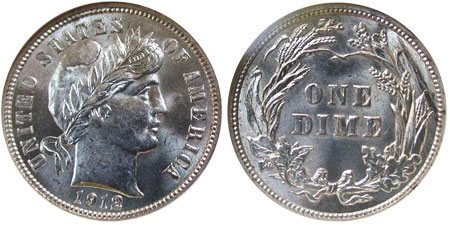
Updated Design
As early as 1887, United States Mint Director James P. Kimball began advocating for an update to the designs of silver coins. In his annual report, he mentioned that citizens generally did not consider their nation’s coinage to be “an expression of art of their time.” Kimball did not pursue the redesign on his own since he believed this authority was held by Congress. Instead, he lobbied for a change in law that specifically allowed the Treasury to change coin designs after a minimum period of 25 years in use.
Design Competition
Once the law was passed, the Treasury announced a competition to select the new coin designs. Ten of the best-known American artists were invited to enter the competition, but after disagreement on the terms, the competition was opened to the general public. Around 300 entries were received, but none were determined to be satisfactory. With the competition deemed a failure, Charles Barber was appointed to create the new designs. It must be noted that Barber had been a member of the panel in change of judging the entries and was well-known for his opposition of outside designs. All the while, his aim may have been to create the designs himself.
The obverse design of the Barber Dime features the head of Liberty, facing right. Most of her hair is concealed under a large Phrygian cap, adorned with an olive branch and headband inscribed LIBERTY. The words UNITED STATES OF AMERICA appear around the edge, with the date below. The designer’s initial “B” appears on the truncation of the neck. The reverse design remained largely identical to the prior series, with an agricultural wreath enclosing the denomination ONE DIME.
The Barber Dime would be issued until 1916, when it was replaced by the Mercury Dime. This series featured a design by Adolph A. Weinman, which was considerably more well received by the public and remains one of the most popular U.S. coin series to collect.